
СРАВНИТЕЛЬНЫЙ АНАЛИЗ ТЕХНОЛОГИЙ УСТРАНЕНИЯ ПРОТЕЧЕК И ТРЕЩИН В БЕТОННЫХ ГТС
СРАВНИТЕЛЬНЫЙ АНАЛИЗ ТЕХНОЛОГИЙ УСТРАНЕНИЯ ПРОТЕЧЕК И ТРЕЩИН В БЕТОННЫХ ГТС

Аннотация
В статье рассматриваются технологии устранения протечек и трещин в бетонных гидротехнических сооружениях. Предложен подход, в котором устранение протечек и трещин рассматривается через связь причины дефекта, способа его выявления, технологии ремонта и последующего контроля состояния конструкции. Выделены основные группы причин возникновения протечек и обосновано, что наибольший эффект достигается при переходе к предупреждающей организации работ. Выполнен сравнительный анализ основных подходов: инъекционного заполнения трещин, поверхностной герметизации, подводного ремонта, ремонта в локально осушаемой зоне, а также применения самозалечивающихся водонепроницаемых составов. Сформирована система повышения эффективности устранения протечек и трещин в бетонных ГТС, основанная на раннем выявлении дефекта, классификации его причин, выборе технологии с учетом условий доступа и режима фильтрации, а также на проверке результата по данным повторного контроля. Полученные выводы могут быть использованы при подготовке регламентов обследования и ремонта бетонных ГТС.
1. Introduction
Concrete hydraulic structures constitute the backbone of water management and energy infrastructure, the reliability of which determines the safety of water-retaining systems, the stability of water-use regimes, and the level of protection of adjacent territories. A significant proportion of such structures has been in operation for extended periods; as they age, defects accumulate within the body of dams and other concrete hydraulic structures, associated with temperature variations, foundation deformations, chemical processes, design errors, violations of concreting technology, and subsequent wear. Cracks and leaks thus become among the most critical indicators of degradation, as they signify a loss of material integrity, alterations in filtration paths, and a reduction in the operational reliability of the structure. In the Russian regulatory context, the relevance of the problem is determined by the requirements imposed on owners and operating organizations of hydraulic structures. Federal Law No. 117-FZ “On the Safety of Hydraulic Structures” establishes the legal basis for ensuring the safety of hydraulic structures and defines the responsibilities related to their safe operation. The engineering requirements are further specified in SP 58.13330.2019 “Hydraulic Structures. Basic Provisions”, which applies to designed, constructed, operated, reconstructed, conserved, and decommissioned hydraulic structures. For concrete and reinforced concrete dams, SP 40.13330.2012 is also significant, as it regulates the design requirements for this type of hydraulic structure. In addition, the current Federal Rules and Regulations approved by Rostechnadzor Order No. 151 of May 8, 2024 strengthen the practical importance of regular maintenance, monitoring, and timely repair as elements of hydraulic structure safety management , , , .
In particular, a review of documented cases of damage to arch dams indicates that the causes of crack formation are typically related to thermal, chemical, external, and design–construction factors, while the presence of open and deeply penetrating cracks necessitates specialized assessment and the selection of the most appropriate intervention method . At the same time, a key challenge lies in the contradiction between the selection of optimal technologies and the substantiation of their effectiveness in a specific case, which has defined the object and scope of the present study.
The aim of the study is to conduct a comparative analysis of technologies for eliminating leaks and cracks in concrete hydraulic structures and to propose an algorithm for their optimal selection.
2. Research methods and principles
The methodological basis of the study is formed by comparative and scenario-based approaches. A theoretical analysis, comparison, and generalization of studies devoted to the application of technologies for eliminating leaks and cracks in concrete hydraulic structures were carried out. For the purpose of comparative analysis of various solutions, an integral efficiency coefficient of the leak elimination system was used (1):
where Es is the integral efficiency of system s; Ps is the normalized indicator of resistance to filtration failure after repair; Ks is the normalized indicator of residual permeability; Hs is the normalized indicator of the recovery capacity of the material or repair system; Ms is the normalized indicator of the timeliness of defect detection; w1,w2,w3,w4 are weighting coefficients, the sum of which equals 1.
To substantiate the weighting coefficients used in the integral efficiency coefficient, a pilot expert survey was conducted. The expert group included six specialists whose professional experience was related to the design, inspection, repair, and operation of hydraulic structures. The experts were anonymized as E1-E6. The group included two specialists in hydraulic structure design, one specialist in technical inspection and safety assessment, one specialist in repair technologies, one specialist in waterproofing and injection materials, and one specialist representing operational practice (Table 1).
The experts were asked to distribute 100 points among four evaluation criteria: resistance to filtration failure after repair, reduction of residual permeability, recovery capacity of the material or repair system, and timeliness of defect detection. The resulting weights were calculated as the normalized average score for each criterion:
where wj is the weight of criterion j; bij is the number of points assigned by expert i to criterion j; m is the number of experts; n is the number of criteria. Since each expert distributed 100 points, the denominator equals 100m. To check the consistency of expert judgments, the coefficient of variation was calculated for each criterion:
where sj is the standard deviation of expert scores for criterion j, and bˉj is the average expert score for criterion j. The obtained coefficients of variation did not exceed 0,10, which indicates an acceptable level of agreement among experts for a pilot study.
Results of the expert weighting procedure
Expert | Resistance to filtration failure after repair, Ps | Reduction of residual permeability, 1-Ks | Recovery capacity, Hs | Timeliness of defect detection, Ms |
E1 | 36 | 24 | 20 | 20 |
E2 | 34 | 26 | 21 | 19 |
E3 | 35 | 25 | 18 | 22 |
E4 | 37 | 23 | 20 | 20 |
E5 | 33 | 26 | 22 | 19 |
E6 | 35 | 26 | 19 | 20 |
Average score | 35 | 25 | 20 | 20 |
Weight | 0.35 | 0.25 | 0.20 | 0.20 |
Coefficient of variation | 0.04 | 0.05 | 0.07 | 0.05 |
Thus, the final weighting coefficients were w1=0.35, w2=0.25, w3=0.20, and w4=0.20. The highest weight was assigned to resistance to filtration failure after repair, since the primary engineering task in eliminating leaks in concrete hydraulic structures is to prevent repeated filtration breakthrough. The second most significant criterion was the reduction of residual permeability. Recovery capacity and timeliness of defect detection received equal weights, as they characterize the preventive component of the proposed approach and its ability to reduce the likelihood of repeated damage.
3. Main results
A leak in a concrete hydraulic structure is, as a rule, the result of the action of a single cause or their combination. In the scientific literature, various causative factors are identified, which can be presented in the form of a classification (Fig. 1).
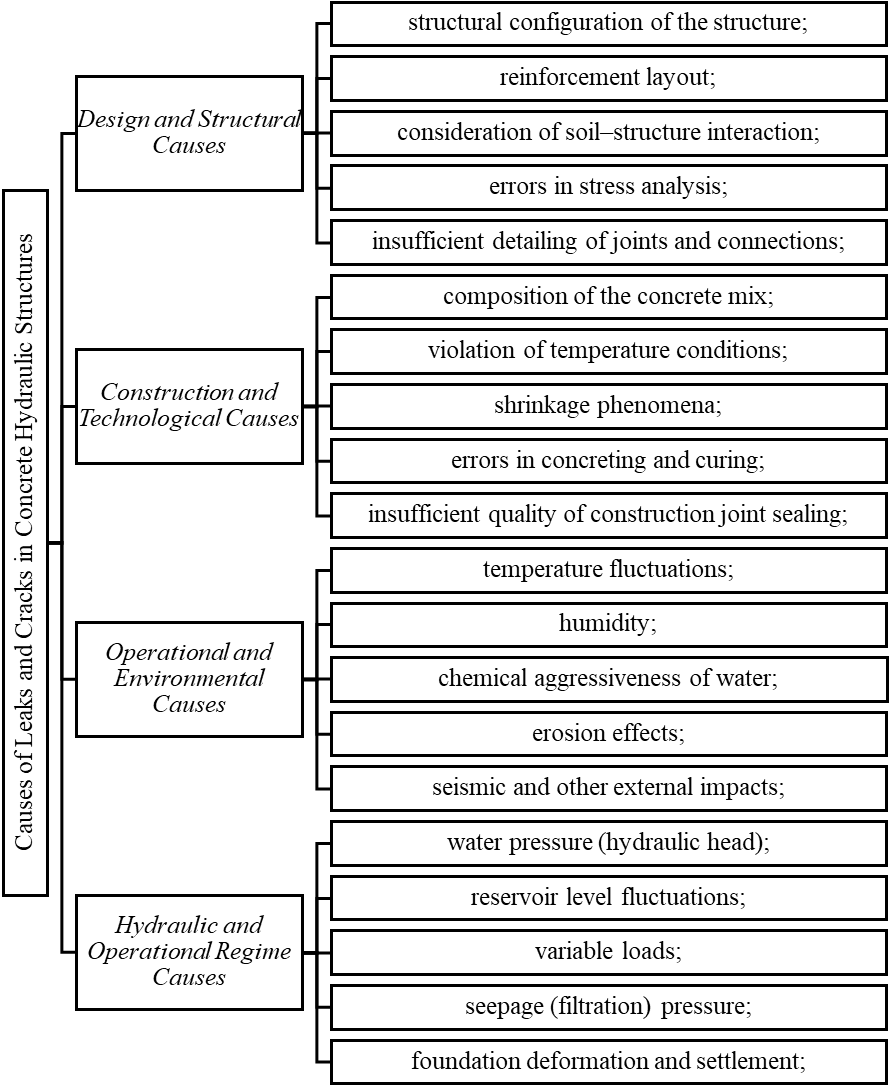
Classification of causes of leaks in hydraulic structures
first, the same external manifestation in the form of filtration through a crack may be caused by different mechanisms;
second, a repair method selected without considering the origin of the defect often eliminates the consequence but not the source of the damage. For this reason, diagnosis of the causes must precede the selection of the sealing technology.
In this regard, a preventive approach to leak elimination appears promising, as it begins prior to emergency repair. In this case, the starting point is the timely detection of the defect and the refinement of crack parameters. It should be noted that, for concrete hydraulic structures, especially those located in the underwater zone, the task of detection has long remained one of the most challenging; modern methods are oriented toward the use of data acquisition sensors, visual systems, and robotic carriers with digital image processing. At the same time, the underwater part of the structure must be inspected in a specific manner due to low visibility, biofouling, complex surface geometry, currents, and limited access as such. Based on a review of technologies for monitoring underwater cracks, it can be noted that the greatest prospects are associated with non-destructive inspection methods, image acquisition, and subsequent automated data processing, as this sequence of operations enables the implementation of the principle of early intervention .
The next aspect in the implementation of a preventive (proactive) approach consists in reducing the sensitivity of the structure to the re-opening of microcracks and to the development of filtration processes. In this regard, materials with capillary-crystalline action, oriented toward self-healing (i.e., materials that stimulate the restoration of the density of the concrete structure in the presence of moisture), are of particular interest. Experimental data indicate that the method of introducing such materials affects the outcome, since under damage caused by water pressure, freeze–thaw cycles, and mechanical loading, the best recovery performance is achieved when the material is applied during the curing period; however, in the case of pre-existing cracks, a noticeable effect is provided by internal incorporation followed by water curing. The study reports high recovery ratios for certain types of damage and effective crack closure due to the formation of crystalline products .
It is important to emphasize that the organization of leak elimination in concrete hydraulic structures can be arranged according to various schemes (Table 2).
Organization of leak elimination in concrete hydraulic structure
based on [5], [6], [7]
Approach | Object | Conditions for implementation | Strengths | Limitations | Rational area of application |
Crack injection | local crack, filtration channel, joint | access to the injection zone is required | targeted restoration of watertightness, relatively high process controllability | dependence of results on crack width, surface roughness, and injection pressure | local leaks, established filtration paths |
Surface sealing and barrier coatings | surface of the pressure zone, areas at risk of re-opening | access to the surface and properly prepared substrate are required | interception of filtration from the pressure side, protection of large high-risk areas | high requirements for surface preparation quality | areas with risk of hydraulic fracturing, zones prone to re-opening |
Direct underwater repair | damage in the underwater zone | operations are carried out in a water environment | no need to take the structure out of operation | high labor intensity, influence of water on operation quality | deep or hard-to-access underwater defects |
Repair in a locally dewatered zone | underwater defect requiring precise substrate preparation | creation of a dry working chamber is required | more controlled conditions for material application | increased complexity of work organization and equipment | critical underwater areas with high quality requirements |
Use of self-healing waterproof materials | microcracks, initial damage | applied during manufacturing, curing, or early repair stages | reduction of permeability and slowing of defect development | limited effectiveness for large crack openings | prevention of microdamage development |
System of early monitoring and targeted intervention | potentially hazardous zones of the structure | continuous or periodic monitoring is assumed | reduction of response time and share of emergency repairs | depends on organizational and technological support | operation of long-service-life structures |
Based on Table 2, the data presented in the review of technologies for repairing damaged underwater concrete structures appear to be of particular relevance, indicating that modern practice involves the division of solutions into direct underwater operations and operations conducted in a dry environment. Within these groups, distinctions are made between underwater concreting, injection methods, coatings and adhesive systems, methods of local dewatering of the working area, as well as solutions involving robotic equipment. Repair materials of four main types are used: cast compositions, injection materials, coatings and adhesive systems, and self-healing materials. Epoxy injection systems are identified as the most commonly used materials for crack repair , , .
At the same time, improving the efficiency of leak elimination requires a sequential organization of work—the system should be based on continuous condition monitoring, early detection of anomalies, differentiation of defect causes, selection of the intervention method based on crack characteristics, and mandatory verification of the result (Fig. 2):
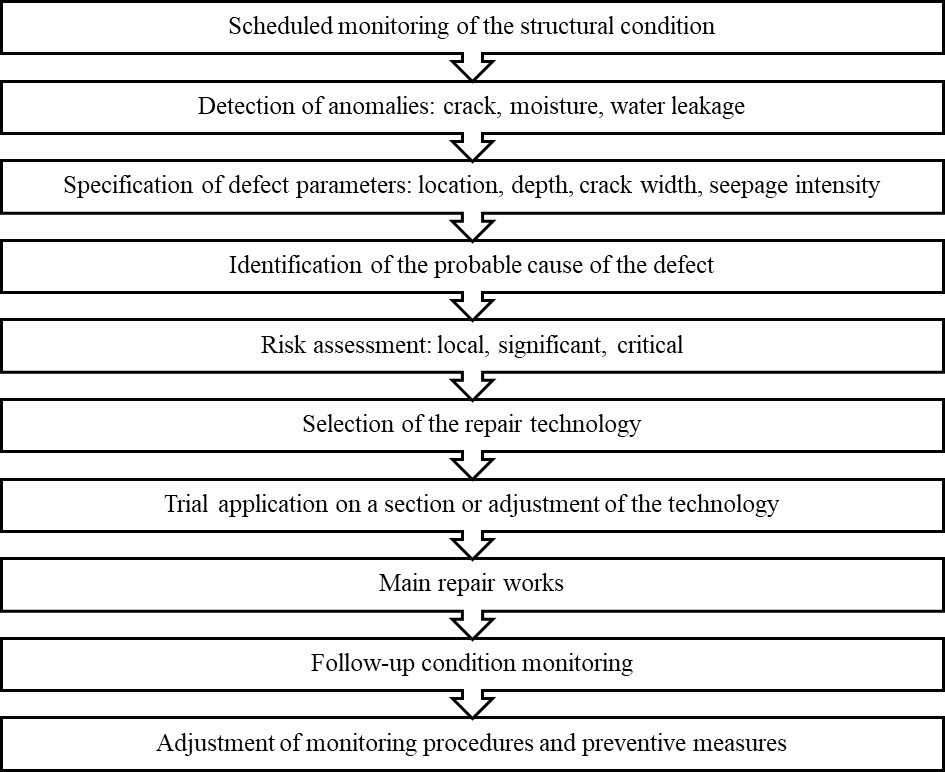
Algorithm for developing a system to improve the efficiency of eliminating leaks and cracks in concrete hydraulic structures based on a preventive approach
The key role in a preventive system is played by the quality of diagnostics at an early stage, as modern methods for monitoring cracks and filtration are evolving toward increased sensitivity to initial manifestations of defects; traditional methods, by contrast, are typically insufficiently sensitive to shallow and early-stage damage , , . Therefore, the most effective repair system begins with earlier detection of signs of water ingress, which is confirmed by the modeling performed using the integral efficiency coefficient of the leak elimination system (Fig. 3, Fig. 4).
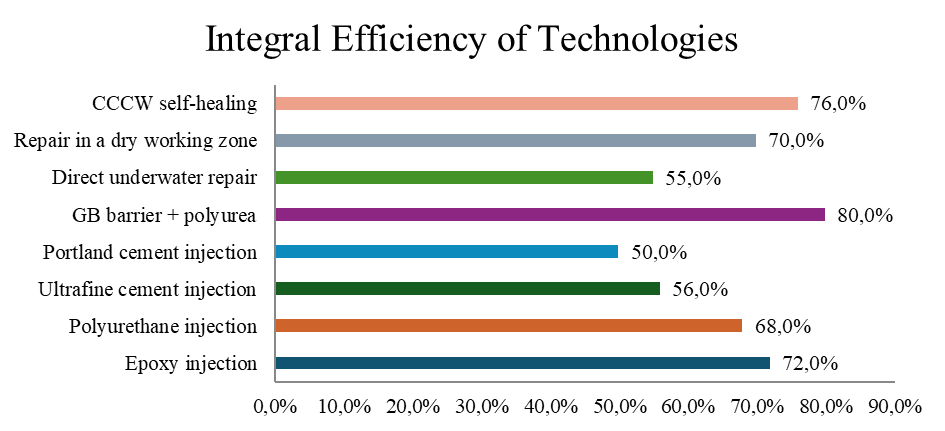
Integral efficiency coefficient of technologies for eliminating leaks and cracks in concrete hydraulic structures
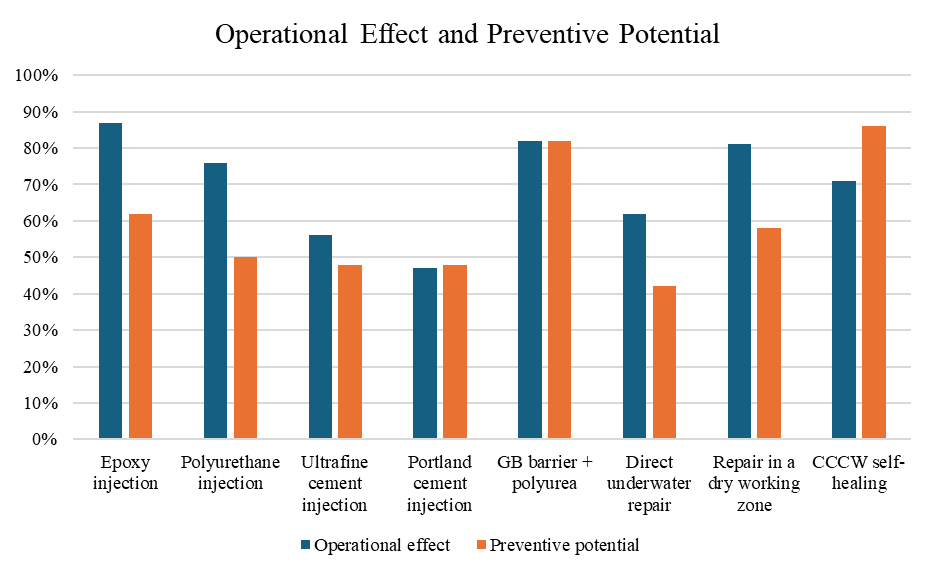
Operational effect and preventive potential within the framework of evaluating the efficiency of technologies for eliminating leaks and cracks in concrete hydraulic structures
4. Conclusion
Thus, the conducted analysis shows that the elimination of leaks and cracks in concrete hydraulic structures should be considered as part of a system for ensuring structural reliability. The main difficulty lies in the multifactorial nature of the defect, as cracks and subsequent filtration arise under the influence of design, construction, environmental, and hydraulic factors, which often overlap. For this reason, a single universal repair method does not exist as such. At the same time, the most rational approach is associated with the alignment of tasks of early defect detection, determination of its origin, selection of technology taking into account access conditions, and subsequent verification of the result.